
Simple Car Battery Charger
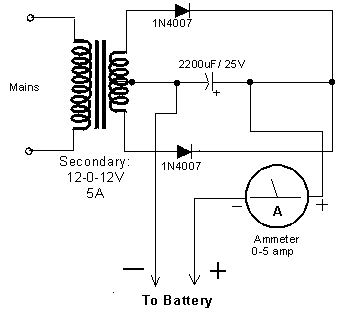
This very simple circuit uses a transformer ,two diodes , a capacitor and an
ammeter.
To charge a battery just connect the + and - terminals of the circuit to the
corresponding terminals of the battery.
When the battery is not charged, the ammeter reading shows 1-3 amps.
When the battery is fully charged the ammeter reads Zero or nearly zero, after
which the battery should be removed from the
charger.
The circuit is a full wave rectifier using 2 diodes for rectification. The
capacitor is used for smoothing.
I think the circuit works fine without the capacitor since the battery itself
acts a BIG capacitor. But when you are using the
circuit to supply 12V (as a battery eliminator) the capacitor needs to be
present.
Care should be taken NOT to reverse the + and - terminals while connecting it to
the battery.
Title: Simple Car Battery Charger
electronic circuit
Source: www.electronic-circuits-diagrams.com
Published on: 2005-02-01
Reads: 2627
Print version: 
Other electronic circuits and schematics from Power
-
A simple step-up converter (6V to 12V)
-
LASER Power Supply
-
12 Volt 30 Amp PSU
-
Power-Off Time Delay Relay
-
High Voltage, Low Current Supply
-
Fuse Monitor / Alarm
-
Ultra low drop linear voltage regulator
-
Solid State Tesla Coil/High Voltage Generator
-
Solar charger for lead-acid batteries
-
10 Amp 13.8 Volt Power Supply